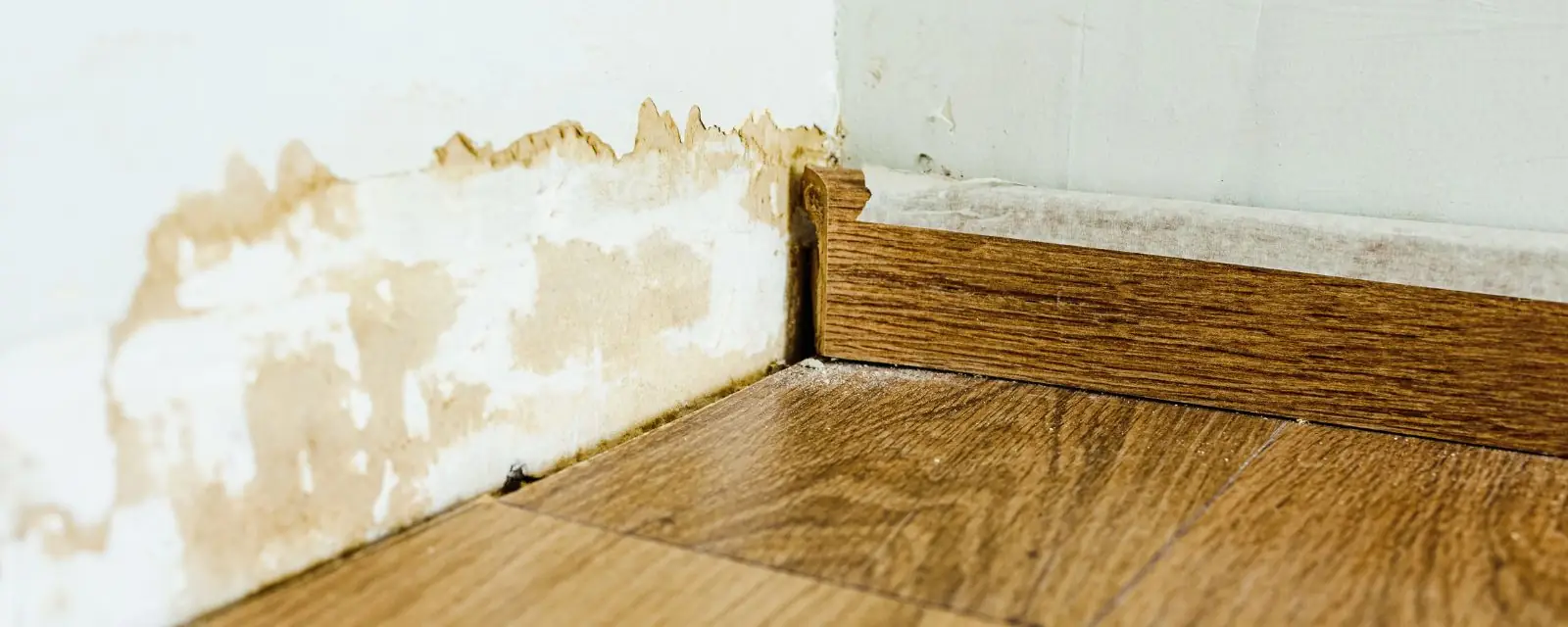
The signs people notice first
The signs of water damage in Holliston, MA homes are rarely dramatic. They are a faint stain, a smell in the closet or a floor that feels a little soft. The earlier you catch them, the smaller the repair usually is.
Water leaves a pattern. It stains, it swells, it stinks and it makes noise. A single clue may be nothing, but two or three together almost always mean moisture is present.
If you see active dripping or a sagging ceiling, stop reading and act. Our emergency water removal crews can be sent right away.
What you can see
Visual signs are the easiest to spot and the easiest to explain away. Look in the corners, along baseboards and under sinks.
- Brown, yellow or tan rings on ceilings and walls
- Paint or wallpaper that bubbles, peels or cracks
- Baseboards or door casings that swell or pull away
- Floors that cup, buckle or lift at the seams
- White chalky residue or rust marks on walls and basement floors
- Dark spots or fuzzy growth on drywall, grout or closets
A stain that looks dry may still hide a wet cavity. Moisture meters and thermal imaging cameras show what the eye cannot.
Hidden places to check after you notice one sign
One sign usually means more. If you find a stain on a ceiling, check the wall below it and the room above it. If you find a soft baseboard, check the opposite side of the wall for the same pattern.
Bring a flashlight and a screwdriver. Probe baseboards, window sills and the base of door casings gently. Wood that gives easily or crumbles is wet or has been wet for a long time.
Look at the exterior too. Gutters that overflow, downspouts that dump next to the foundation and soil that slopes toward the house all send water where it should not go. Fixing grading is a landscaping job, not restoration, but it often explains an interior pattern.
What you can smell and hear
A musty or earthy smell is one of the most reliable clues. It means something is damp enough to grow microbes, and it often appears before any stain. If the smell is stronger when the heat or air conditioning runs, the moisture may be in the ductwork.
Sound helps too. A faint drip inside a wall, a hiss behind a closet or a toilet that runs by itself suggests a pressurized leak. Turn off appliances and listen in a quiet house.
Smells that return after cleaning mean the source is still wet. Air fresheners cover the problem for a short time at best.
What your bills and meter show
A water bill that climbs for no reason is a leak signal. Check the water meter with every fixture off. If the dial or digital reading still moves, water is going somewhere.
Slow leaks hide for months. A running toilet, a dripping valve or a pinhole in a copper line can waste a lot of water without leaving a stain. Compare this month's bill to the same month last year.
An unusually high bill is one clue among many. Pair it with a walk around the house, and call a plumber if the meter confirms movement.
Symptom, likely cause and next step
This table pairs common symptoms with what usually causes them. It is a starting point, not a diagnosis.
| Symptom | Likely cause | Next step |
|---|---|---|
| Ceiling stain that grows | Roof or upstairs plumbing leak | Find the source, dry the cavity, check insulation |
| Soft baseboard or wall base | Slow leak inside the wall or floor-level moisture | Moisture reading, open the wall base |
| Musty smell, no visible stain | Damp insulation, carpet pad or crawl space | Locate the damp material and dry it |
| Cupped hardwood boards | Moisture from below or a plumbing leak | Find the source, then dry before sanding |
| Meter moves with everything off | Hidden supply line leak | Call a plumber, then restoration if material is wet |
| Peeling paint on a basement wall | Moisture moving through masonry | Check grading, gutters and sump, then dry |
Several symptoms at once point to a larger problem than any one clue alone. Photograph everything and write down when you first noticed it.
Pipes, appliances and the usual household suspects
Most indoor leaks come from a short list of sources. Washing machine hoses harden and burst. Water heater tanks rust at the base. Dishwasher supply lines loosen. Ice maker lines kink and crack.
Each of these leaves its own clue. A rusted pan under a water heater, a damp cabinet floor under a sink and a stain behind a refrigerator all point to a specific fixture. Replace aging hoses before they fail.
Frozen pipes are a different case, and the damage shows up after the thaw. A pipe that split in a cold wall can drip for days before a stain appears. A sudden loss of water pressure in winter is a clue worth checking.
How professionals confirm hidden moisture
A pin or pinless moisture meter reads how wet drywall, wood and plaster are compared with a dry reference spot. A thermal imaging camera shows cooler patches where evaporation is happening behind a surface. Neither tool replaces a careful look, but together they give an answer without cutting into the wall.
When readings point to a cavity, a small inspection hole lets the crew look inside and check the insulation and framing. That hole is far cheaper to patch than a wall that rotted for another season.
Ask any company to show you the readings it took and where, and see our water mitigation page for how drying is monitored. Numbers on a screen and a map of the wet zones make the scope easy to explain and easy to question.
What to do when you find a sign
Stop the water first if you can. Shut off the supply to the fixture, or the main valve if the source is unknown. Photograph the damage with something for scale.
Then call someone to check it. A plumber finds and fixes the leak, and restoration dries and rebuilds what got wet. Massachusetts health guidance wants wet areas dry inside a day when that is possible.
Our water damage repair page explains the rebuild stage. Crews also serve Ashland and Hopkinton, and the same warning signs apply there.
Frequently asked questions
What is the earliest sign of water damage?
Usually a smell or a soft spot. A musty odor in a closet or a baseboard that gives under your thumb often appears before any visible stain.
Can water damage exist with no stain?
Yes. Water behind a wall, inside a floor or above a ceiling may show no surface mark for a long time. Moisture meters and thermal imaging cameras find it.
Is a high water bill always a leak?
No, but it is worth checking. Turn off all fixtures and see whether the meter still moves. If it does, a hidden leak is likely.
Does a musty smell always mean mold?
It means something is damp enough to grow microbes. Mold is one possibility. Questions about health belong with a physician.
Will my insurance cover what I find?
Sudden and accidental damage is often covered, and slow leaks from neglect often are not. Check your policy and ask your insurer.
Do older Holliston houses hide water damage differently?
Yes. The Massachusetts Historical Commission survey lists Colonial, Federal and Greek Revival houses, and plaster walls and stone foundations can hide moisture for a long time before a stain appears.
Dealing with this right now?
Call the 24/7 line. Scope and price are explained before work starts.
☎ Call (508) 446-9244